Schmidt SciencesHAVI Convening EventLondon14 October 2026
Download PDF

Playing Heaven

Remapping Early Modern Neo-Confucian Worlds with AI

  • Javier ChaPresenting
  • Donghyeok Choi
  • Eric Chow
  • Chien-Cho Chan

The University of Hong Kong

  • Yan Hon Michael ChungPresenting

The Hong Kong University of Science and Technology

  • Miguel Escobar Varela
  • Florin-Stefan Morar

National University of Singapore

Schmidt SciencesSchmidt SciencesHAVI Convening EventLondon14 October 2026playingheaven.ai/talks/2026-10-14/schmidt

Four Challenges

  1. 01

    Multilingual Intellectual History

    Challenge

    Historical accounts tend to privilege a dominant and prestigious written language, even though multilingualism has long been an ordinary condition of human life. In early modern East Asia, Neo-Confucian scholarship circulated principally in Literary Sinitic, but its dissemination and reception involved multiple linguistic communities, literary forms, and sociopolitical settings.

    Our Approach

    The multilingual capabilities of LLMs extend well beyond the reach of any individual historian, allowing us to recover, connect, and compare historical sources in Manchu, vernacular Chinese, various forms of literary Sinitic, including those practised in Korea. This work provides a basis for wider perspectives involving Japan, Okinawa, Vietnam, and Jesuit scholarship.

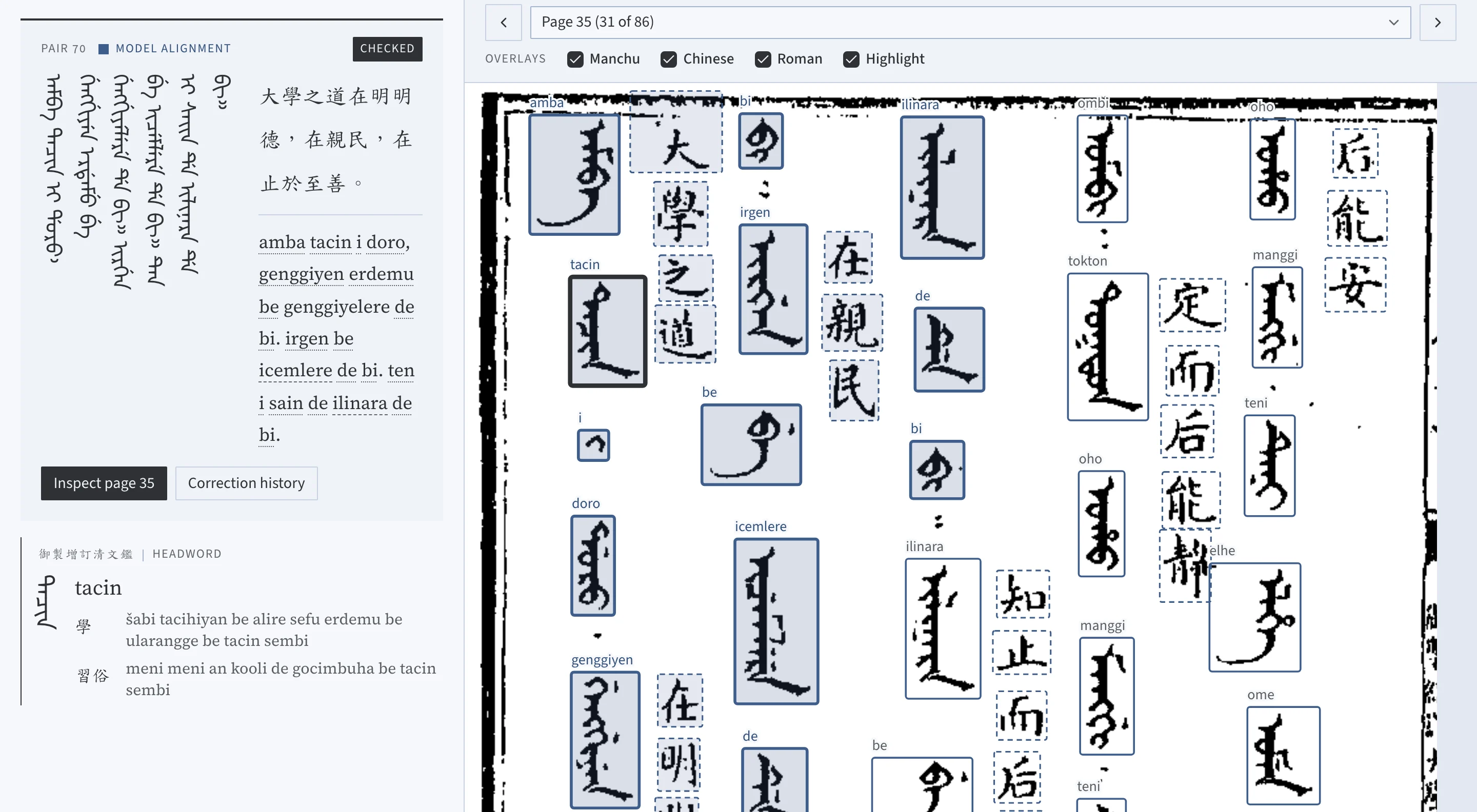
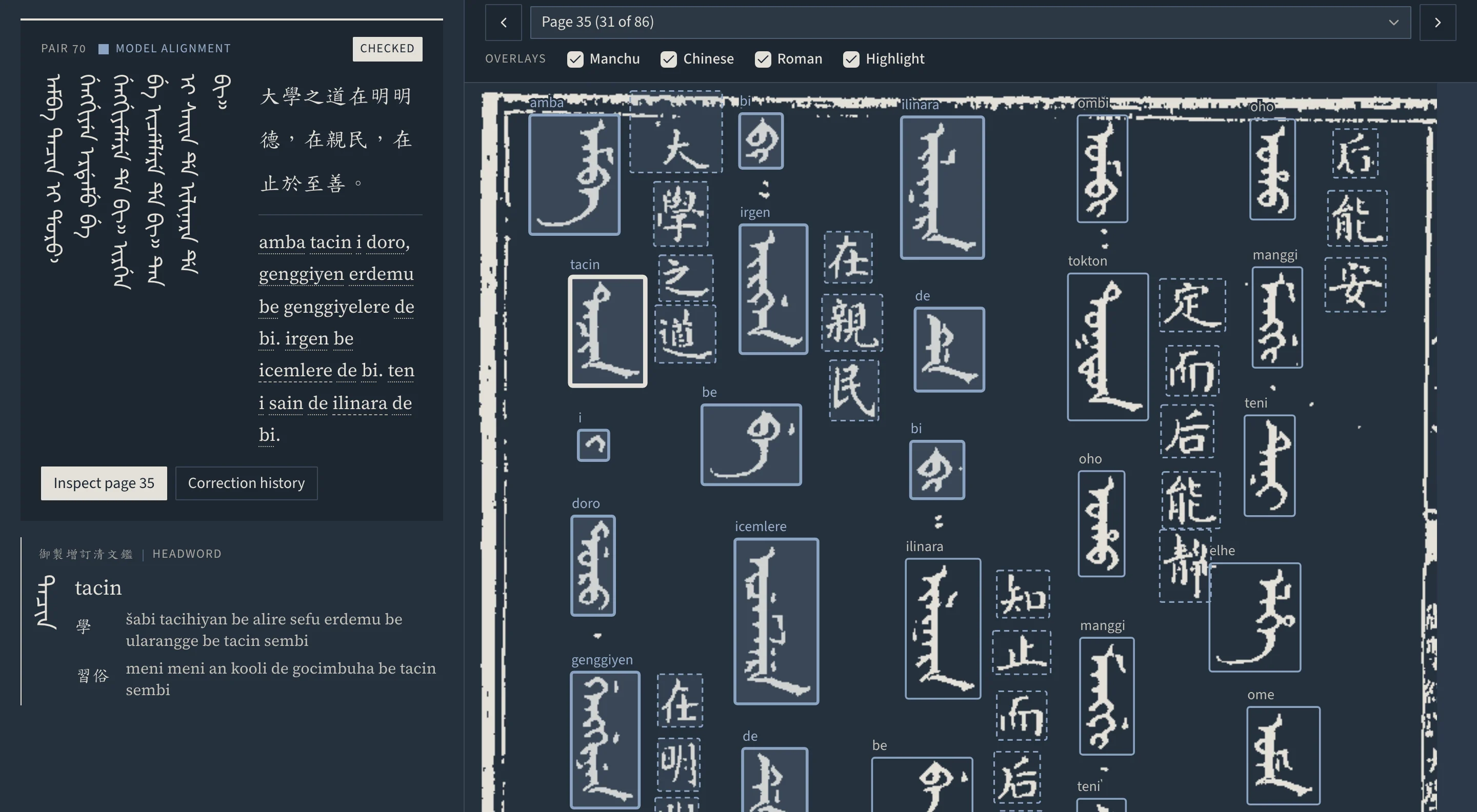
    From the Manchu page to the Chinese, word by wordThree stations: a window on page 35 of the Manchu Great Learning with the words the OCR run found boxed; the Manchu transcribed as a column of words, amba tacin i doro, genggiyen erdemu be genggiyelere de bi; and the Chinese 大學之道在明明德 beside it, each word tied to the characters it translates.大學之道在明明德
  2. 02

    The Boundaries of Modern Disciplines

    Challenge

    In early modern East Asia, literature, moral philosophy, and philology were overlapping scholarly pursuits, with individual scholars placing different emphases on each. Modern academic divisions, however, treat them as distinct fields of inquiry.

    Our Approach

    Our computational research environments, Pivot 機 and Traces 跡, employ specialized AI agents to bring together literary, philosophical, and philological developments into an integrated field of view.

    Three overlapping pursuits, parted by modern divisions, brought into one field of viewSchematic. Three overlapping lenses labelled Literary History, Philosophy and Philology, with scholars as dots, most standing where the lenses overlap and leaning to one or another; two hard vertical rules cut the field into three, the modern divisions. When our approach appears the rules recede and one dashed lapis frame encloses all three lenses.Literary HistoryPhilosophyPhilology
  3. 03

    From Individual Texts to Intellectual Formations

    Challenge

    Intellectual history requires moving from individual passages and debates to larger formations such as schools of thought and literary and aesthetic movements. We also need to factor in that some scholars also pursued forms of semiotics that questioned the a priori existence of fixed concepts. A further challenge is accounting for the contributions of thousands of less prominent scholars who participated in the formation, evolution, and dissemination of these intellectual and cultural traditions.

    Our Approach

    We organize specialized AI agents in a research pipeline our team has developed, which we call agentic knowledge distillation. The agents analyze passages, synthesize higher-order interpretations of essays, and simulate debates among scholars. Each successive layer remains linked to the underlying records, allowing historians to examine the evidence at every interpretive level.

    From a passage to a formation, and backSchematic. A passage, the essay it is in, the author's writings, and a formation: tiles of an author's peers with a formation drawn across them in dashed lapis. With our approach, a lapis line returns from the formation to the passage.
  4. 04

    Understanding and Evaluating Machine Interpretation

    Challenge

    LLMs can now produce interpretation-like readings of primary sources and secondary scholarship, extending the possibilities of computational hermeneutics beyond earlier approaches centred on word frequencies and semantic drift. The tradeoff is that we know little about how models generate these sophisticated outputs. A further challenge involves evaluating model performance, since interpretive tasks involve a range of plausible responses rather than a single right or wrong answer.

    Our Approach

    We have experimented with persona-vector steering and sparse autoencoders, and are considering contrastive embedding models for literary-style analysis. We are also exploring evaluation methods involving expert focus groups and comparisons of outputs generated by multiple models, with particular attention to whether their interpretations are plausible, supported by historical evidence, and defensible against alternative readings.

    A model's layers, the readings it gives, and the readings judged against the sourceSchematic: a stack of a model's layers with one marked in lapis, and three short readings leaving to the right, two solid and competing, with opposed arrows between them, and one dashed. With our approach an arrow enters the marked layer, an intervention, and a source stands at the right: the two readings are tied to it, and the dashed one's tie ends in a cross, contradicted by the source. It represents the question, not a result.

Neo-Confucianism and Related Cultural Movements

For more than a millennium, Neo-Confucianism and related intellectual traditions informed literary and aesthetic practices, moral philosophy, and philological inquiry in East Asia and beyond. These traditions developed in close interaction, giving rise to related and sometimes competing schools of thought and cultural movements. Thousands of scholars in China, Korea, Japan, Okinawa, and Vietnam, as well as Jesuit missionaries, participated in these exchanges. Their writings, intellectual affiliations, scholarly fellowships, and cultural practices reflected considerable diversity within and across linguistic and political boundaries. Playing Heaven investigates how these activities and relationships contributed to larger intellectual, social, and cultural developments.

Chronology, 750 to 1850A chronology from 750 to 1850 CE on one linear scale, three strands each with the figures who belong to it beneath it, each on a lifespan rule of their own: literary and cultural movements, ancient-style prose through the whole period with the Jiangxi School of Poetry, Archaism and the Six Works of Genius as blocks on it and vernacular literature rising beneath it from the late Ming, with Han Yu, Wang Anshi, Su Shi, Yi Kyubo, Li Mengyang, Wang Shizhen, Jin Shengtan; moral philosophy, the Learning of the Way with the Learning of the Mind and, beneath it from 1583, Western Learning in the Jesuits' colour, with Zhu Xi, Wang Yangming, T’oegye, Matteo Ricci; philology as a thin undercurrent that thickens into Evidential Learning in the late Ming, with Huang Zongxi, Ogyū Sorai, two dashed ties running from Li Mengyang's and Wang Shizhen's rules round the right margin to Sorai's. Each person's colour is their polity's on the map. Beneath the axis, the Kangxi (1677) and Qianlong (1755/56) Manchu translation projects.LITERARY AND CULTURAL MOVEMENTSAncient-Style Prose(guwen 古文)Vernacular LiteratureArchaism(guwenci 古文辭)Jiangxi School of Poetry(Jiangxi shipai 江西詩派)Six Works of Genius(liucaizishu 六才子書)Han Yu 韓愈 768–824Wang Anshi 王安石 1021–1086Su Shi 蘇軾 1037–1101Yi Kyubo 李奎報 1168–1241Li Mengyang 李夢陽 1473–1529Wang Shizhen 王世貞 1526–1590Jin Shengtan 金聖嘆 1608–1661MORAL PHILOSOPHYLearning of the Way (daoxue 道學)Learning of the Mind (xinxue 心學)Western Learning (xixue 西學)Zhu Xi 朱熹 1130–1200Wang Yangming 王陽明 1472–1529T’oegye 退溪 1501–1570Matteo Ricci 利瑪竇 1552–1610PHILOLOGYEvidential Learning(kaozhengxue 考證學)Huang Zongxi 黃宗羲 1610–1695Ogyū Sorai 荻生徂徠 1666–172880010001200140016001800CE1677 Kangxi-Era Manchu Translation1755/56 Qianlong-Era Translation
East Asia, c. 1700East Asia around 1700 on Natural Earth coastlines, the sea tinted, with the approximate extents of the Qing empire (with its lands north of the Amur and Primorye, as the Treaty of Nerchinsk left them), Chosŏn, the Tokugawa shogunate, the Ryūkyū kingdom and Đại Việt, each named with its Chinese name in the colour its figures take on the chronology, the names standing clear of every drawn line; their capitals, Beijing, Hanyang, Edo, Shuri and Thăng Long, as unlabelled dots. A dotted curve, schematic, marks the Society of Jesus's sea route to Europe: from a marker at Macao south through the South China Sea east of Hainan and out of the frame; no single voyage is drawn.Qing 清Chosŏn朝鮮Tokugawa Shogunate德川幕府Ryūkyū Kingdom琉球國Đại Việt 大越JesuitsEast Asia, c. 1700

Scholarly Cases of the Song and Yuan Dynasties(Song Yuan xue’an 宋元學案)

宋元學案 by volumeThe 宋元學案 by volume: 100 segments, each as wide as the volume's share of the audit's 3165 person-entry headings.

Huang Zongxi, Huang Baijia, and Quan Zuwang; 1838 edition. 100 fascicles, 2,389 scholars.

Scholarly Cases of Ming Confucians(Mingru xue’an 明儒學案)

明儒學案 by volumeThe 明儒學案 by scholarly case: 19 segments, each as wide as the persons the case lists (ChinaKnowledge's table), 210 in all.

Huang Zongxi, completed 1676. 62 fascicles, 19 scholarly cases, 202 scholars.

Bringing Manchu Sources into Focus

The research edition with page 35 of the Great Learning open: the scan at the right with every Manchu word the run found outlined and read, the Chinese between the columns; at the left, pair 70, the Chinese sentence with its Manchu, marked checked, and the dictionary headword tacin.
The project’s seal: hergen in Manchu beside 文, cut in intaglio

We fine-tuned a VLM for historical Manchu transcription and then integrated word detection to further improve recognition. Building on this research, HKUST and the Staatsbibliothek zu Berlin signed an agreement to advance OCR research on the library’s extensive Manchu holdings, managed by its CrossAsia division.

For Playing Heaven, our digital research environment brings Manchu transcriptions, corresponding Chinese passages, and original page images together for comparative investigation. Scholars can inspect and correct individual readings, compare accounts across languages, and pursue historical questions arising from differences in their perspectives and representations.

CrossAsia — Manchu OCR Announcement blog.crossasia.org/manchu-ocr/

96.28%
Word AccuracyReal Handwritten Manchu Documents
Llama-3.2-11B-VisionFine-Tuned for Historical ManchuYan Hon Michael Chung and Donghyeok Choi

Imperial Translation of the Four Books and Five Classics

We align successive Manchu translations of the Four Books and Five Classics (Sishu Wujing 四書五經), the classical canon redefined by Neo-Confucian scholars, to examine how the Kangxi and Qianlong courts rendered and revised classical terminology. Comparisons across editions allow us to identify recurring translation choices and investigate the editorial decisions of the two imperial courts as they rendered the highly literary language of the Chinese classics into vernacular Manchu.

Analects of Confucius 4.4Kangxi (1677) and Qianlong (1755/56) Editions

子曰:苟志於仁矣,無惡也。The Master said: if the will is set on humaneness, there is no wickedness.

Kangxi (1677)Literary Sinitic 漢文Qianlong (1755/56)
  1. kungdzi hendumeConfucius says子曰fudzi hendumeThe Master says
  2. unenggi苟unenggi
  3. gūninIntention志mujinWill
  4. de於de
  5. gosin仁gosin
  6. —矣—
  7. akū無akū
  8. ehe惡ehe
  9. kai也kai

Unchanged RenderingChanged RenderingGrammatical Particle or Unaligned Element

Pivot 機: Agentic Knowledge Distillation

Pivot organizes specialized AI agents to analyse historical texts and construct successive layers of interpretation, from individual passages to essays, author profiles, and comparative corpora.

Agent skills define the analytical tasks, while Pivot maintains the resulting interpretations as source-linked records that historians can inspect, correct, and revise.

From a passage to a comparative interpretation, and backFive panels telescoping left to right: a passage as one column of characters; the section, the few columns of one argumentative unit with the passage's column picked out and a lapis bracket over them; the essay, all its columns with the section's run washed in lapis; the author profile, a selection of essays as rectangles of varying size with this essay's picked out; the comparative interpretation, this author's tiles beside another's with a dashed lapis loop across both, open. At the last step a lapis line returns beneath the panels to the passage: Every interpretation remains linked to its sources..PASSAGESECTIONESSAY§1§2§3§4§5AUTHOR PROFILEBROADER COMPARISONSEvery interpretation remains linked to its sources.
  1. Original text and source
  2. Analysis of an argumentative unit
  3. Synthesis of the essay’s arguments
  4. Interpretation based on a selection of writings
  5. Comparison across authors and texts

1Select and Segment the Text

pivot › read_text PV.SRC.000484

文與可畫篔簹谷偃竹記, line 4 of 29

  1. §1Epistemological Theory of Ink Bamboo Painting
  2. §2Philosophical Allusions and Methodological Transmission
  3. §3Epistolary Banter and Exchange of the Yundang Scroll
  4. §4The Culinary-Poetic Interaction in Yundang Valley
  5. §5Sudden Bereavement and the Commemorative Function of Humor

Historical Source

故畫竹,必先得成竹於胸中

Therefore, to paint bamboo one must first have the complete bamboo in the breast.

Su Shi 蘇軾, 1079, working translation; the essay divided into five argumentative units by the plan step

2Apply an Agent Skill

pivot › start_run analyze-primary work=PV.SRC.000484 from=sections

primary-sections

Agent Skill

Analyse the planned sections of one classical Chinese essay that the task names.

SKILL.md; workflow analyze-primary, step sections

3Construct a Section Interpretation

pivot › read_records PV.SEC.002053

Recorded Model Output

Artistic creation requires a complete, pre-conceived mental image of the whole bamboo prior to applying the brush. Piecemeal construction (adding segment by segment, leaf by leaf) destroys organic integrity. Execution must be immediate and swift to match mental vision.

Section record §1, arguments; Gemini 3.6 Flash; excerpt

4Examine the Interpretive Dimensions

Interpretive Dimensions

  • C1Semiotics and Epistemology 名實How artistic knowledge relates to the representation of its subject.
  • C9Aesthetics and the Way 文 / 道How artistic practice relates to a larger account of the Way.

成竹於胸中 Complete Bamboo in the Mind內外不一 Non-alignment of Internal and External心手不相應 Lack of Mutual Response Between Mind and Hand

The section record’s alignment with taxonomy version 1 (ten categories); the explanations are editorial glosses, not Pivot’s definitions

5Construct Larger Interpretations

pivot › read_records PV.ESS.000483

Recorded Model Output

Thesis, from the five section records:

genuine artistic creation is an organic manifestation of unified inner vision and physical action

心 / 手 Mind vs. Hand意 / 法 Idea vs. Method內 / 外 Internal vs. External數尺 / 萬尺 Physical Scale vs. Structural Momentum

Essay synthesis; Gemini 3.6 Flash; a clause of its thesis and its dialectical pairs

6Construct Larger Interpretations

pivot › read_records PV.PRF.000009

“The profile is provisional and conditioned on exactly these essays.”

Corpus Scale

164 selected essays and 761 section records

Pivot, Original Pivot reading, 13 October 2026; not the whole of Su Shi’s surviving work

7Construct Larger Interpretations

Recorded Debate Outcome

What are 王安石 (Wang Anshi) and 蘇軾 (Su Shi)’s positions on what is 道 (dao)?

Compared in a Pivot Debate over both authors’ distilled records; outcome PV.MDB.000002, provisional. The next slide.

No compare-authors run exists for the pair; the comparison was conducted as a Debate

8Construct Larger Interpretations

pivot › find_links PV.ESS.000483

Source Return

  1. PV.ESS.000483the essay synthesis
  2. PV.SEC.002053 §1the section record
  3. PV.SRC.000484, line 4故畫竹,必先得成竹於胸中

Each record keeps its route back to the passage; inspection, correction and revision happen at every link

Pivot Debate: Wang Anshi and Su Shi on Dao

Pivot’s Debate feature uses AI agents to compare interpretations of Wang Anshi’s and Su Shi’s writings, examining how each conceived of Dao and its relationship to language, literature, and government. By drawing on their respective essays and broader intellectual positions, the agents identify fundamental philosophical disagreements and contrasting worldviews that their superficially shared classical vocabulary might otherwise obscure.

Model
  • Gemini 3.8 Flash (High)
  • Gemini 3.8 Flash (Medium)
  • DeepSeek V4 Flash
  • Kimi K3
  • GLM-5.3
Question

What are 王安石 (Wang Anshi) and 蘇軾 (Su Shi)’s positions on what is 道 (dao)?

Participants
  1. First王安石 (Wang Anshi)
  2. Second蘇軾 (Su Shi)
  3. positions read from the dossier by the model, not the authors speaking

Rounds 2 Comparison between interpretations

Dossier
  • PV.ESS.000678與祖擇之書, Wang Anshi
  • PV.PRF.000007Profile, Wang Anshi
  • PV.ESS.000363答張文潛書, Su Shi
  • PV.SRC.000843Bol, This Culture of Ours, excerpt
  1. Model selected
  2. Question submitted
  3. Dossier assembled
  4. Debate begun: PV.DEB.000002, run PV.RUN.002528

Recorded Debate Output

Position read for 王安石 (Wang Anshi)

Wang Anshi conceives of Dao (道) as grounded in practical governance, statecraft, and administrative order (「治教政令」、「實用和實踐」). True literature (「聖人之所謂文」) is ontologically identical with sage statecraft, policy decrees, and institutional execution […]

[PV.SRC.000843] [PV.ESS.000678] [PV.PRF.000007]

Position read for 蘇軾 (Su Shi)

Su Shi conceives of Dao (道) not as an authoritarian monopoly or rigid statutory code, but as a living, immanent dynamic of nature and balance (「中庸」) […] literature is co-extensive and contemporaneous with Dao (「與道俱」), emerging organically from moral character rather than enforced conformity.

[PV.SRC.000843] [PV.ESS.000363]

They differ onThe relationship between Literature (文) and Dao (道)

Wang Wang views true literature (「聖人之所謂文」) as coterminous with the actual administrative machinery and moral self-admonition of statecraft, subordinating rhetorical composition to governance [PV.SRC.000843] [PV.ESS.000678]

Su Su views literature as co-extensive and unfolding with the Way (「與道俱」), maintaining that creative, unforced literary engagement allows individuals to independently attain sagehood [PV.SRC.000843]

Source return

  1. PV.ESS.000678與祖擇之書Wang Anshi’s letter, as its essay synthesis reads it
  2. PV.ESS.000363答張文潛書Su Shi’s letter, as its essay synthesis reads it
  3. PV.PRF.000007Profile · Wang Anshithe author profile across his selected essays

Debate outcome PV.MDB.000002, a provisional synthesis written by Gemini 3.8 Flash (Medium): draft, 28 September 2026; Pivot’s validation left it requires review; stale since 1 October, when a new text version changed sections it rests on. The participants’ own models are not in the public record.

How Do Language Models Construct Interpretations?

LLMs can produce sophisticated readings of historical texts, but how do they arrive at these interpretations? We examine their internal representations and test how interventions affect their responses, without fine-tuning the underlying language models.

01Persona-Vector Steering (Intervention)

We introduced activation-based interventions to test whether models could reproduce the documented intellectual positions of Wang Anshi and Su Shi. Steering altered tone and register but did not reliably change substantive positions.

  • Tone and RegisterChanged
  • Intellectual PositionNot Reliably Reproduced

02Internal Representations (Mechanistic Probing)

We use sparse autoencoders to examine internal features associated with different readings. Initial experiments found a stronger distinction between intellectual positions when models answered questions about the texts, although the effect remained inconclusive on held-out comparisons.

Stance Gap, Standard DeviationsTwo horizontal bars from a zero baseline, in standard deviations: Initial Analysis +0.67 (p < 0.001, all 863 pairs); Held-Out Test +0.25 (p = 0.13, 210 held-out pairs). The held-out bar is dashed. Answering a question on the issue; layer 60, Gemma 3 27B.STANCE GAP, STANDARD DEVIATIONSAnswering a question on the issue; layer 60, Gemma 3 27BInitial Analysisall 863 pairs+0.67p < 0.001Held-Out Test210 held-out pairs+0.25p = 0.1300.250.50.75
Differences between intellectual positions were more apparent during question answering; the held-out result was inconclusive.

Next Steps for Playing Heaven

  1. 01

    Traces 跡: Rethinking Intellectual Formations

    We are developing Traces to reassess inherited schools, lineages, and intellectual classifications against the writings and relationships of thousands of scholars. Beginning with extensive retrospective histories of Confucian learning, we aim to extend this investigation to other historical compilations that organized intellectual and cultural traditions.

    Open Traces 跡 traces.playingheaven.ai/

  2. 02

    Literary Styles and Aesthetic Practices

    Develop specialized embedding models and classifiers to identify literary styles, rhetorical conventions, and aesthetic features. Examine how these practices circulated among scholars and contributed to literary movements and intellectual affiliations.

  3. 03

    Evaluating Machine-Generated Interpretations

    As agents produce larger collections of interpretive records, we need formal methods to assess their quality. We plan to combine domain-expert focus groups with comparisons among LLM agents to establish the range of historically defensible interpretations and distinguish plausible readings from those contradicted by the evidence.

  4. 04
    Longer-Term Direction

    Transregional Intellectual History

    Building on our research into intellectual connections between China and Korea and our work on Manchu sources, we hope to extend these investigations to a wider range of linguistic and political settings. This would allow us to examine the diversity of intellectual and cultural traditions within China, beyond the southeastern regions that have dominated scholarship, and their development elsewhere in East Asia and beyond. This next stage would follow the current three-year project, subject to further validation and support.

Research material

Citations

Permalink: https://playingheaven.ai/talks/2026-10-14/schmidt/

Landscape suits the presentation.